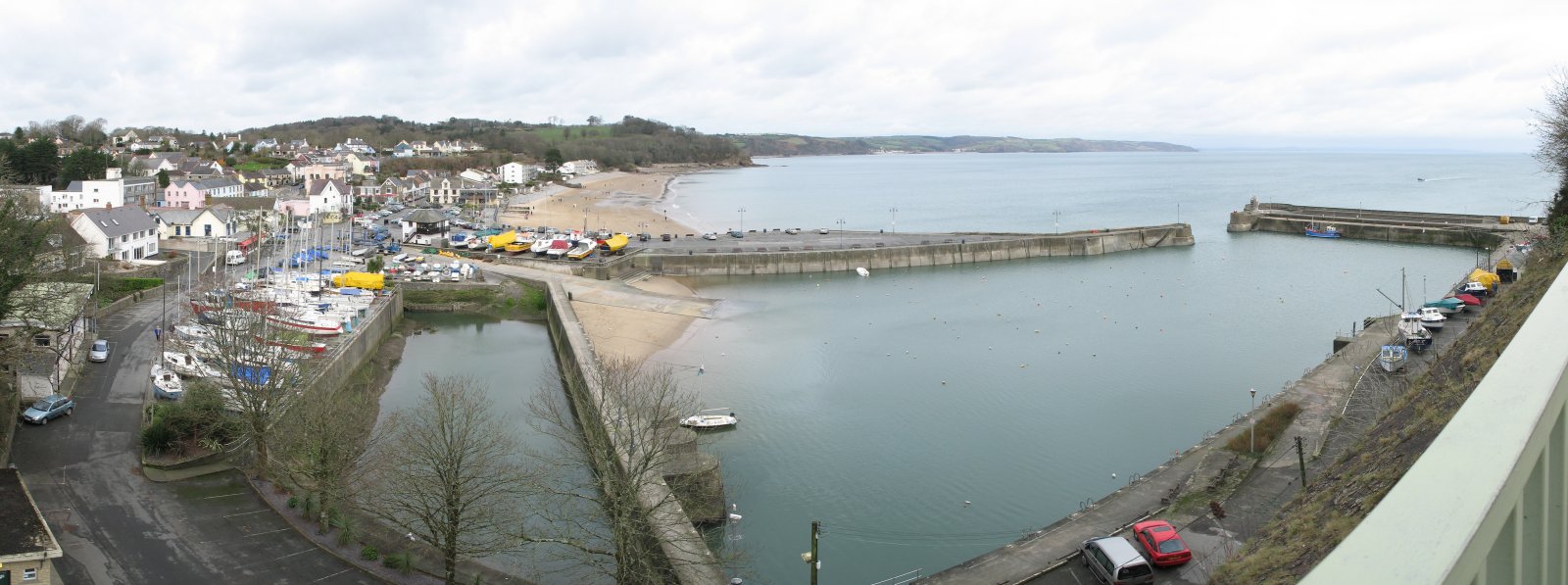
Porthgain is unlike anywhere else on this coast. A tiny inlet in the cliffs was turned into a shipping harbour for slate, granite roadstone and bricks, and when the works closed in the 1930s the machinery went but the architecture stayed: a row of enormous brick storage hoppers looms over the quay, ruined brickworks and stone-crushing buildings stand on the headland, and the harbour walls are still lined with the marks of the trade. It should look grim and instead it is magnificent — red brick and grey rock above green water, with fishing boats and a slipway at the bottom.
The village today is a pub, a couple of eating places, a gallery or two and a small car park, and in summer it is very busy indeed for its size — this is a lunch-and-a-walk destination for half of north Pembrokeshire. The walking justifies it. West along the Coast Path, twenty minutes brings you to Traeth Llyfn, a fine sandy beach reached by a steel staircase, and forty to Abereiddi's Blue Lagoon. East, the path runs to Abercastle past the ruined mill at Aberfelin below Trefin.
There is no beach at Porthgain itself, no shop and very limited parking, so plan around that. As a base it is superb for the north-west coast: St Davids is fifteen minutes, Whitesands twenty, Fishguard twenty-five. Out of season, when the harbour is empty and the hoppers are silhouetted against a winter sea, it is one of the most atmospheric places in Wales.
Cottages in and immediately above the harbour are the ones to hold out for — you can walk to the pub and the Coast Path and let the car sit. There are few of them. The villages a mile or two inland, Llanrhian, Croesgoch and Trefin, carry most of the supply and give easier parking, with Porthgain a five-minute drive or a good walk away.
Signposted from the A487 St Davids–Fishguard road at Croesgoch and Llanrhian, then narrow lanes. The village car park is small; arrive early in summer. No rail nearby; Fishguard Harbour station is about thirty minutes.

.JPG)